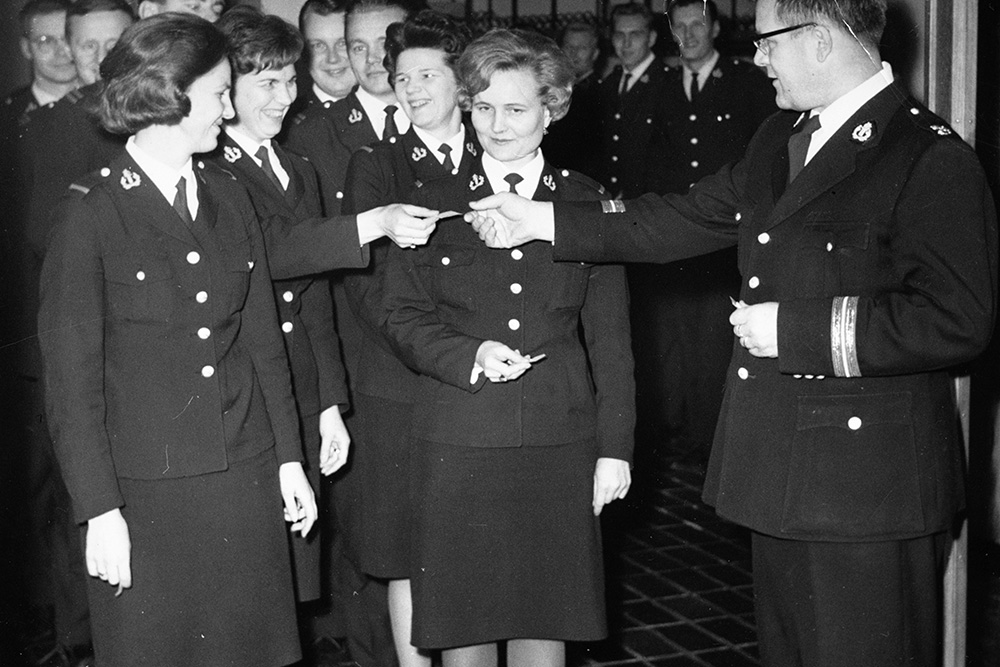
History of aptitude and admission examinations for police officers
There has been a desire to have different types of police officers in different times. Their basic background education has usually been at the average level of Finns. Before the Second World War, a military aspect was emphasised in police training, which was also reflected in the aptitude requirements.
In the 1920s, a “sturdy body” and a military career were preferred, and the reliability of an aspiring police officer meant right-wing affiliation politically. In the same decade, the qualification requirement for the position of a senior constable was a provincial training course, and the qualification requirement for the duties of a sergeant was the first class of the State Police School.
In the 1950s, on the other hand, emphasis was on good physical condition, “general smartness” and a “commanding nature”. The different types of demands reflect the contemporary male ideal, and in some cases the police were even required to exceed these ideals. In 2025, a police officer must be a calm, social and co-operative solver of situations, regardless of gender.
Years 1919 to 1940:
The reliability of a police officer meant political right-wing opinions, and experience in the Civil Guards was recommended in the 1920s. There was frequent turnover of police personnel, and the wages were small. The requirements for serving as a policeman included “good comprehension, a healthy and sturdy body, and an impeccable past”. In addition to vocational subjects, the police officers who had completed the itinerant school were to be also taught general knowledge, writing and arithmetic at the State Police School.
In 1926, the police were required to have:
- a minimum height of 170 cm
- good hearing and vision
- age of 22 to 36 years
- completed compulsory military service or Civil Guard training
- proof of reliability (no left-wing background)
- sobriety and good way of life
- brisk and respectable appearance.
The Mobile Police Command was founded in 1930 against the pressure and radicalism of the extreme right. The Mobile Police Command was responsible for recruit training, in which the recruits committed themselves to being police officers for a couple of years. Military non-commissioned officer training during conscript service was required for courses in the Mobile Police Command. The purpose of the Mobile Police Command was to serve as an impartial special task force of the police.
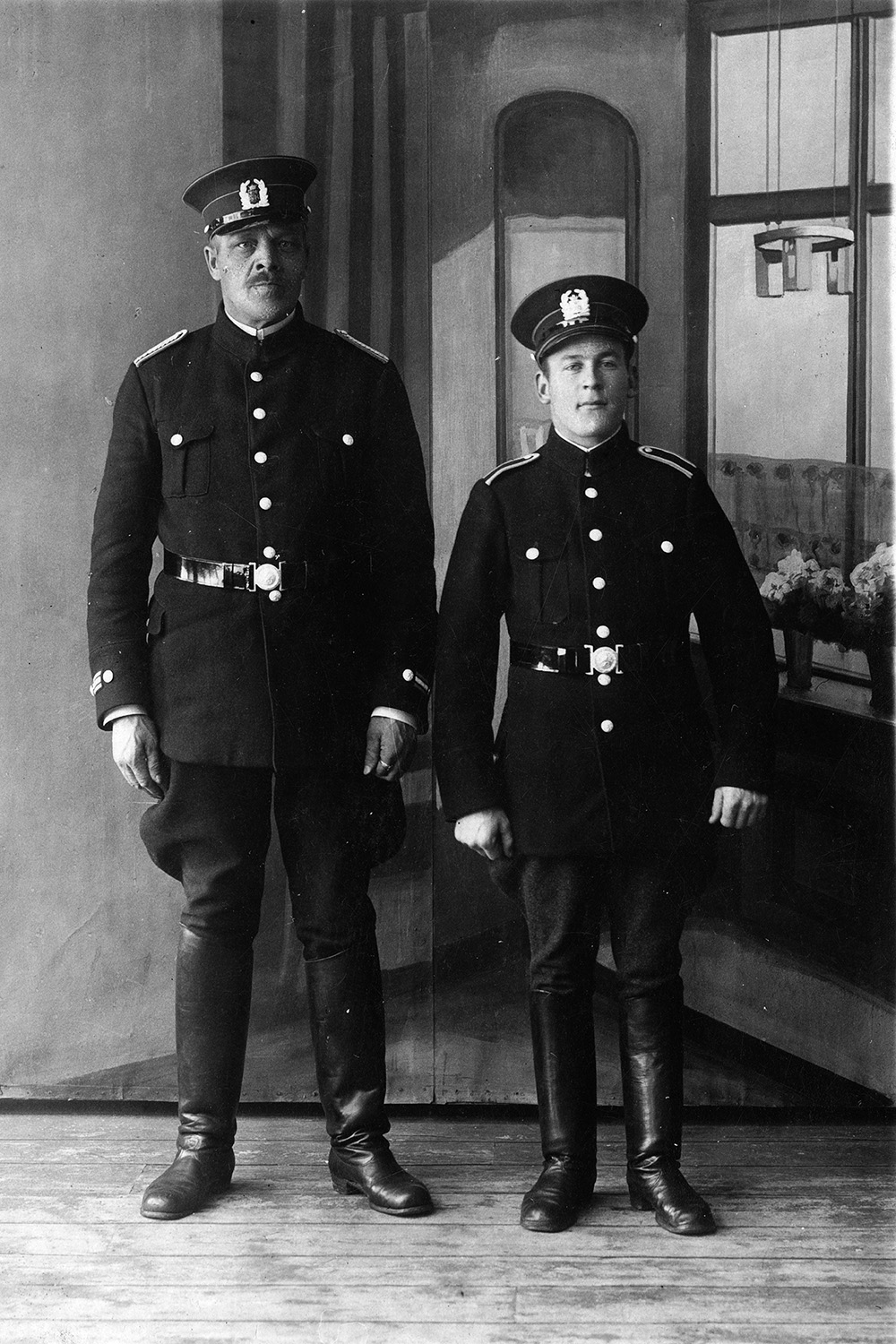
Years 1940 to 1960:
Completely untrained men were still hired as constables in rural police districts. Between 1944 and 1947, the number of police constables grew and the admission requirements were less strict than before. The requirements were tightened again in 1949, and the applicants were subject to intelligence tests and soon also an aptitude test, which tested issues such as memory and perception. The total manpower of the National Traffic Police decreased from 3,000 men in 1946 to 700 men in 1960.
In 1944, the Mobile Police Command became the National Traffic Police and continued the recruit training of police officers. All applicants were required to have performed impeccable front-line service in war. After the wars, the general attitude towards the police changed and, as an example, workers’ organisations gave their public support to the police in the prevention of crime. This was also reflected in an increase in the number of men with a working-class background wanting to become a police officer.
In 1957, 31 per cent of police students had completed secondary school. A policeman had to be:
- in good physical condition
- observant and have initiative
- resourceful, courageous, decisive, and not easily provoked
- moreover, you had to have a balanced commanding nature and be positively open, but not a “windbag”.
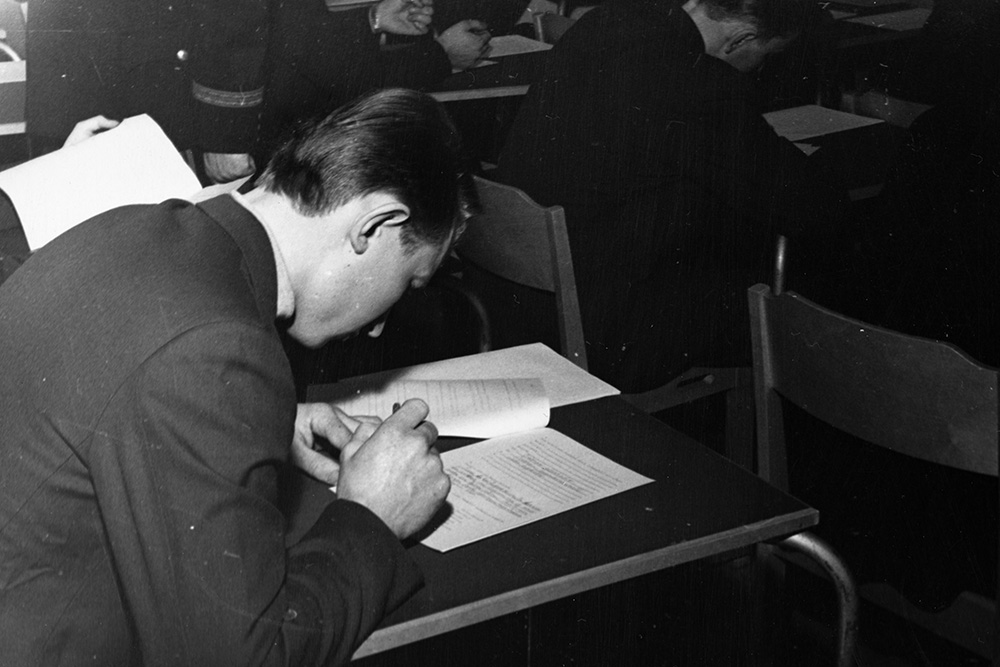
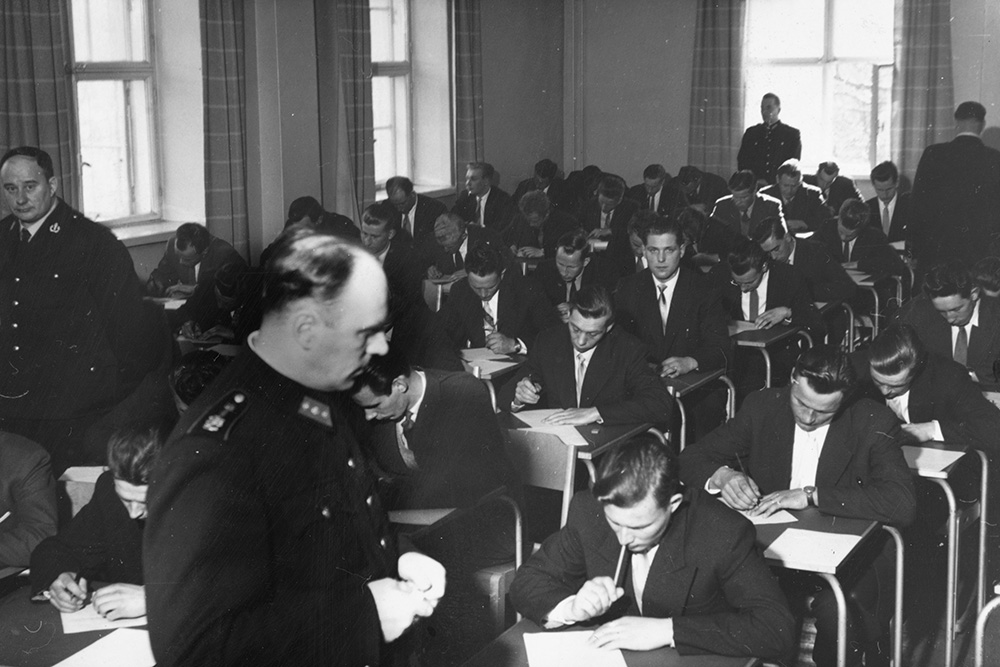
Years 1960 to 1989:
The admission application was to be accompanied by school and medical certificates as well as a statement from the police chief of the applicant’s municipality of residence. The applicant had to be
- impeccable
- 20 to 30 years old
- 175 cm tall
- at least a non-commissioned officer in reserve.
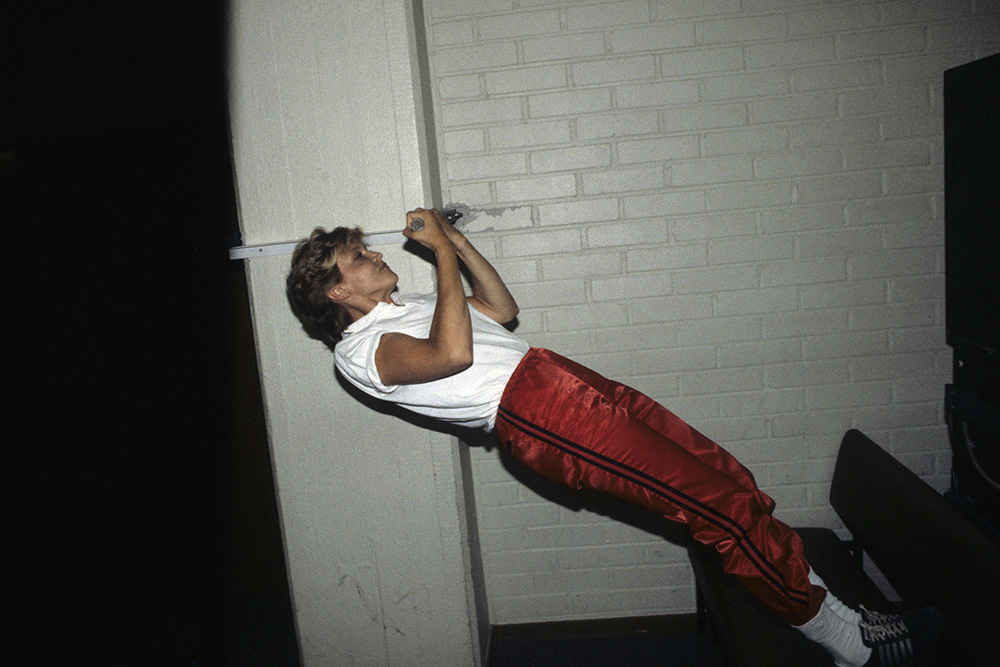
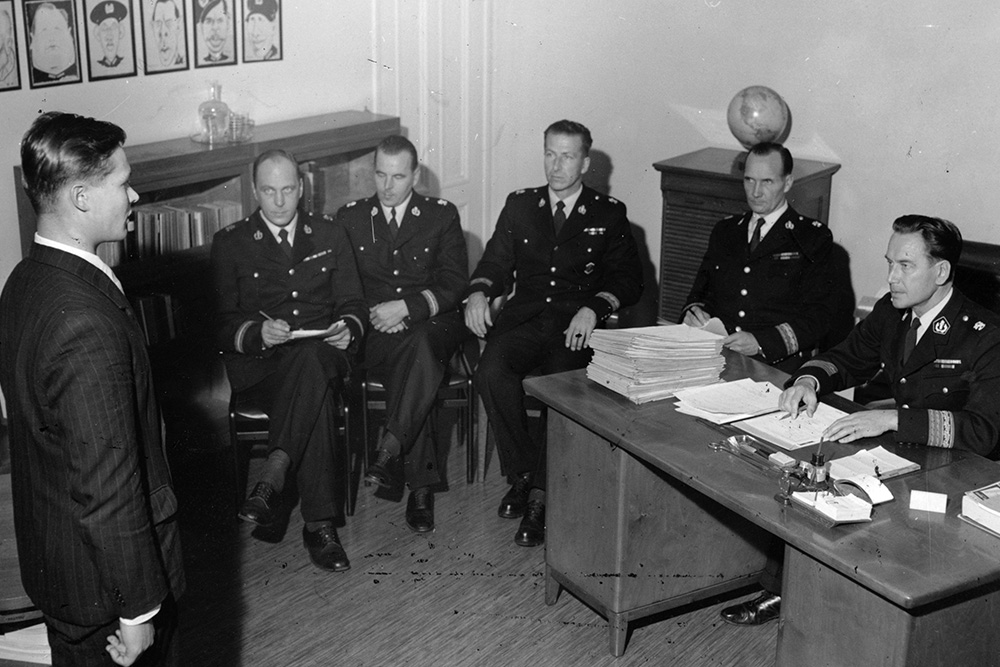
The Cooper test, long jump from a stationary position and pull-ups measured physical fitness. In addition to the fitness test, the admission exam comprised essay writing, a civic knowledge test and aptitude tests. An interview examined quick-wittedness, external appearance and “general smartness”. From the 1970s onwards, women were also allowed to apply to become police officers.
The applicant had to be suitable in terms of mental capacity and attitude:
- tolerant, law-abiding, humane and social
- the applicant’s own finances had to be in order, and the applicant was never allowed to behave in a reprehensible manner
- the Police Decree of 1985 required, as before, men to have had non-commissioned officer training during conscript service
- a matriculation examination was not required, even though most of the applicants actually had a matriculation examination. In 1985, the minimum age for police training was lowered to 18 years.
Years 1990 to 2009:
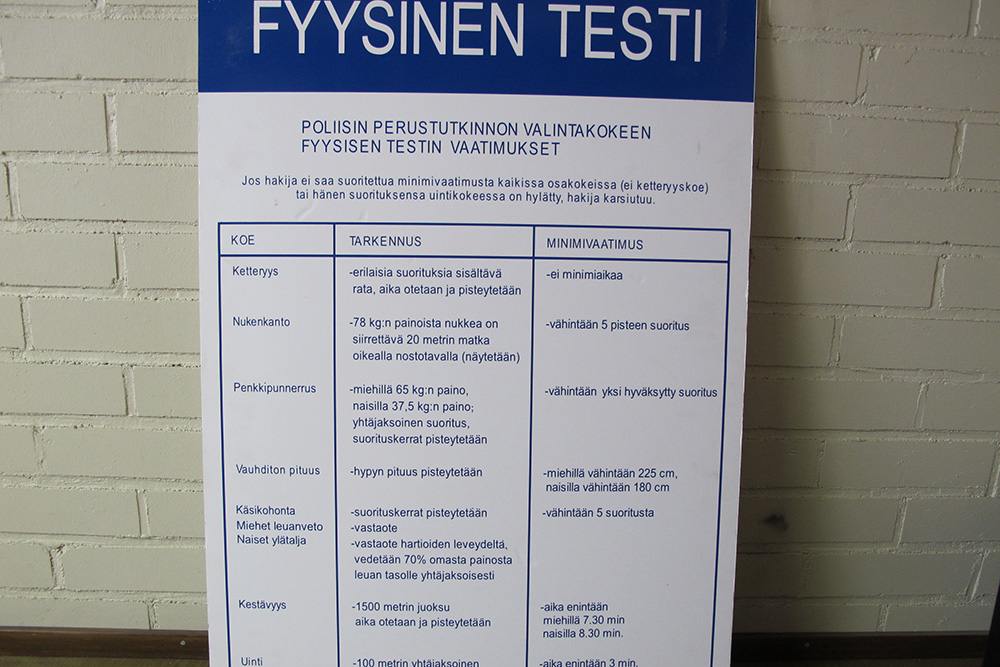
The admission exam in the 1990s began with a fitness test, which included:
- a 1,500 metre run
- agility, elasticity, strength and swimming tests.
After passing the fitness test, an interview of the applicant focused on motivation, sociability and conversational skills. The goal of the interviews was to obtain commensurate information.
The written exam tested general knowledge. The aptitude test tested personality, and written, numerical and spatial reasoning, as well as concentration, memory, perception, tolerance of time pressure and understanding of instructions. Finally, there was an essay in the applicant’s mother tongue.
The decrease in the sizes of the age groups intensified recruitment to the Police Academy. The goal was to have applicants of different ages and educational backgrounds, and especially Swedish-speaking applicants. In 1994, the upper age limit was 35 years, and there were about 20 times more applicants than what the maximum intake of new students was.
Finnish citizenship was required from police officers in the 2000s, while at the same time there was a greater need for police officers with an immigrant background in the police departments. The recruitment efforts focused on women and those belonging to ethnic or other minority groups. The number of applicants decreased, and there were not always enough applicants who met the requirements at the end of the 2000s.
From 2010 onwards:
Admission requirements in the 2020s:
- Finnish citizen
- Education: upper secondary school, matriculation examination, vocational upper secondary qualification, vocational upper secondary qualification under the Adult Education Act, further vocational qualification, specialist vocational qualification or foreign education qualifying for higher education studies.
- Health: no illness or disability that prevents from working as a police officer.
- Vision: without aids at least 0.2 in each eye separately, at least 1.0 when corrected with glasses or contact lenses.
- Hearing: hears ordinary speech with both ears at a distance of four meters without aids.
- Honesty and reliability: the Finnish Security and Intelligence Service (Supo) conducts a security clearance of those who have been admitted to training. The security clearance is affected by fines, convictions and arrests, among other things. The statement takes into account the nature, number and timing of the offences.
- Category B driving licence
- Swimming proficiency certificate.
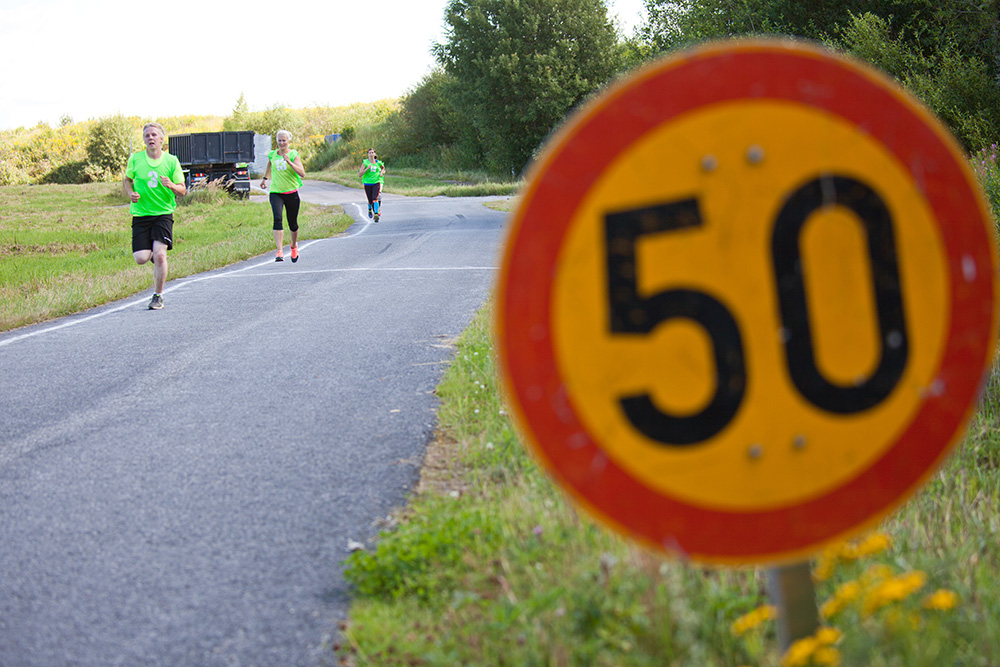
The admission exam first includes a physical test (endurance; 1,500 metre run, agility, pull-ups and bench press), a written test and some of the psychological tests. The second phase comprises the rest of the psychological tests, an individual and group assignment and an interview. In the final result, the physical test accounts for 20 per cent, the written part for 30 per cent and the aptitude test for 50 per cent.
Women’s police training
In the early 20th century, female constables were hired by large police departments to take care of vice squad duties related to vagrants and prostitutes. At first, women did not receive any police training and they could not aspire to do the same tasks as men.
The first female police courses were organised in 1923. The occasional courses covered vice, temperance and child welfare legislation, criminal law, treatment of the mentally ill, health-related education, first aid and gymnastics. The teachers were judges, education experts, representatives of the Defence Forces and personnel of the State Police School. After the wars, women were trained in connection with other police officer training, but separate female police courses were organised again in the 1950s.
From 1973 onwards, women were allowed to apply to become police officers without exemption, but it was more difficult for them than men to get into police training. In the 1980s, the quotas for women were abandoned at the Police Academy. In 1987, 2.2 per cent of all police officers were female officers, but in the early 2020s, about one third of those who applied for and were admitted to police training were women. The proportion of women among those trained as police officers has therefore increased significantly.